
Federal Tax Authority Decision No. 4 of 2026 | Issued 2 June 2026 | Effective 30 July 2026
The Federal Tax Authority has issued Decision No. 4 of 2026, setting out precise rules for how businesses in the UAE must maintain accounting records and commercial books, whether retained as Electronic Copies or Photocopies. While recordkeeping obligations already exist under the Tax Procedures Law, this Decision provides the practical detail on how those records must be stored, preserved and made accessible to the FTA.
Key Definitions
• Electronic Copy: a record created, saved or converted into electronic format that can be viewed, retrieved and read via electronic systems or media.
• Photocopy: a physical reproduction, via photocopying, scanning or photographic means, that preserves the original document’s content and form clearly and legibly.
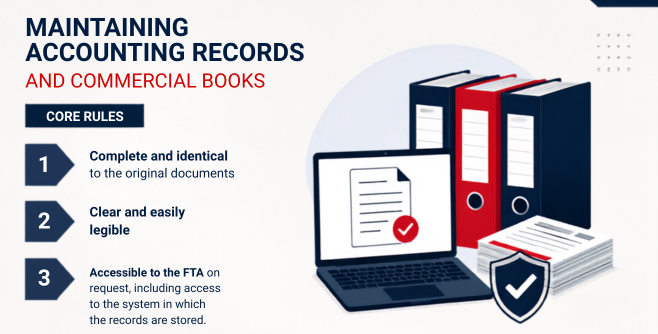
Core Rules
Regardless of format, businesses must ensure their records and commercial books are:
- Complete and identical to the original documents;
- Clear and easily legible; and
- Accessible to the FTA on request, including access to the system in which the records are stored.
Detailed Requirements
Completeness
• Electronic Copies or Photocopies must be identical to the original and must include all pages in their original order.
• Partial scanning of a document is not acceptable — the entire document must be captured.
Quality and Legibility
• Data must be clearly readable when displayed on a computer screen.
• Ink and paper used for Photocopies must be durable enough not to fade over the required retention period.
• Non-coloured photocopies of originally coloured documents are acceptable, provided all details remain legible.
Accessibility
• Where Electronic Copies, or the systems storing them, are protected by encryption or passwords, the business must provide the necessary keys or passwords to the FTA on request.
• Physical storage locations for Photocopies must also be made accessible to the FTA.
Outsourcing Recordkeeping
Businesses may engage a third party, such as an outsourced bookkeeping or document management provider, to maintain their records and commercial books. However, this does not transfer legal responsibility: the business remains fully accountable for ensuring the records are properly maintained and safeguarded, even where a third party physically holds them.
What This Means for Businesses
| Action Points: 1. Audit scanning practices to ensure complete documents, not partial pages, are captured, and confirm scan quality meets legibility standards. 2. Review encryption and access protocols so passwords or encryption keys can be provided promptly if requested by the FTA. 3. Formalize outsourcing arrangements — ensure contracts confirm that ultimate legal responsibility remains with the business, with audit rights built in. 4. Check physical storage conditions for paper-based records to ensure legibility is maintained for the full statutory retention period. |
Decision No. 4 of 2026 is a reminder that how records are kept matters just as much as whether they are kept. Businesses should use the period ahead of the effective date to review their document retention systems, both digital and physical, to avoid compliance gaps during any future FTA audit or information request.