The UAE has officially introduced a Research & Development (R&D) Tax Credit regime through Cabinet Decision No. 215 of 2025, further clarified by Ministerial Decision No. 24 of 2026, under Federal Decree-Law No. 47 of 2022 on Corporate Tax.
Effective for tax periods beginning on or after 1 January 2026, this incentive is a major step toward promoting innovation, attracting foreign investment, and strengthening the UAE’s position as a global hub for technology and knowledge-based industries.
If your business is involved in product development, AI, manufacturing, software, or process innovation, this regime can significantly reduce your Corporate Tax liability.
What Is the UAE R&D Tax Credit?
The UAE R&D Tax Credit allows eligible businesses to claim a percentage of qualifying R&D expenditure and offset it against:
- Corporate Tax liability
- Top-up Tax (for multinational groups, where applicable)
Under the latest Ministerial Decision, the credit is non-refundable, but can be carried forward or transferred subject to specific conditions.
Enhanced Benefit: Tiered Tax Credit Rates
A key addition under the 2026 Ministerial Decision is the tiered incentive structure, linking benefits to both investment size and R&D workforce:
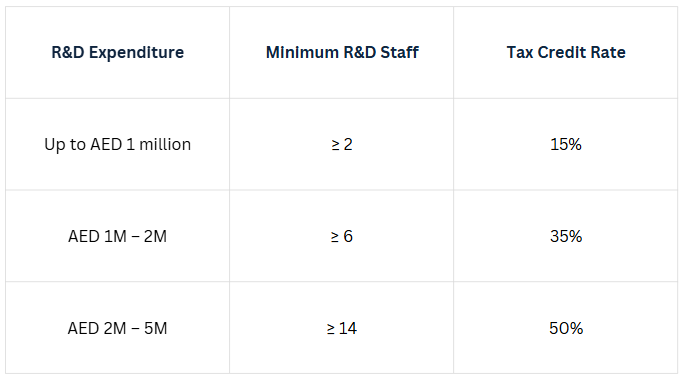
Important: Both expenditure and staff thresholds must be met; otherwise, a lower rate applies.
Who Is Eligible?
To qualify, a business must:
- Be subject to UAE Corporate Tax and/or Top-up Tax
- Conduct qualifying R&D activities within the UAE
- Obtain mandatory pre-approval from the Emirates R&D Council
- Meet minimum R&D employee thresholds
- Bear the financial and economic risk of the R&D project
- Be entitled to returns from the R&D output
Free Zone entities may also qualify if:
- They are subject to 9% Corporate Tax on R&D income, or
- They fall under the Top-up Tax rules
What Qualifies as R&D?
The UAE has adopted internationally aligned criteria (OECD-based). Activities must be:
- Novel – generating new knowledge
- Creative – based on original concepts
- Uncertain – outcomes not known in advance
- Systematic – planned and documented
- Transferable/reproducible
- Excluded: Social sciences, humanities, and arts-related activities.
Eligible R&D Expenditure
Qualifying costs include:
1. Staff Costs
- Salaries, allowances, bonuses, gratuity, and benefits
- Medical insurance and pension contributions
- 30% uplift allowed for overhead allocation
2. Consumable Costs
- Materials, fuel, power, and utilities
- Non-capital licenses
- Clinical trial-related costs
3. Subcontracting Costs
- Must be conducted within the UAE
- Cannot be further subcontracted
- Additional conditions for related parties
4. Cost Contribution Arrangements
Allocation must match expected economic benefits
Must comply with the arm’s length principle
5. Capitalised Development Costs
- Internally generated intangibles may qualify
Key Conditions
Double benefits under multiple tax incentives are not allowed
Minimum AED 500,000 spend per R&D project per tax period
Expenditure must be wholly and exclusively for R&D
Costs funded by government grants are excluded
How the Credit Works
The R&D Tax Credit:
1. Must first offset current Corporate Tax / Top-up Tax liability
2. Can be carried forward (subject to ownership or business continuity)
3. Can be transferred within a group (≥75% ownership condition)
4. Is non-refundable under current rules
If conditions are not met, claw-back provisions apply, and penalties may be imposed.
Additional Key Provisions (New in 2026)
- Mandatory Pre-Approval: Required before claiming the credit
- 7-Year Record Keeping: Detailed technical and financial documentation
- UAE Nexus Requirement: Only R&D conducted within the UAE qualifies
- Staff Location: R&D staff must be physically based in the UAE
- Group Rules: Aggregation of staff and expenditure allowed for Tax Groups
Compliance Requirements
Claims must be submitted with the Corporate Tax Return, including:
- Pre-approval confirmation from the Council
- Audited financial statements
- Detailed R&D cost breakdown
- Senior management declaration
Late submissions are generally not accepted.
Strategic Impact
The UAE R&D Tax Credit is a game-changing incentive:
Opportunities
- Significant reduction in effective tax rate
- Encourages innovation and IP development
- Attracts multinational R&D investments
Challenges
- High compliance and documentation requirements
- Strict eligibility criteria
- Need for alignment with Transfer Pricing and substance rules
Conclusion
The UAE R&D Tax Credit regime, effective from 2026, represents a major opportunity for innovation-driven businesses. Companies that proactively:
- Identify qualifying activities
- Structure R&D operations correctly
- Maintain robust documentation
will gain both tax savings and a competitive advantage. Early planning is critical to fully leverage this incentive and ensure compliance from day one.
How We Can Help
We support businesses with:
- R&D eligibility assessment
- Pre-approval application
- Tax structuring and optimization
- Documentation and audit readiness
Our experts maximize your tax credit benefits while minimizing risk. Contact RMC Tax today for strategic advisory and end-to-end support tailored to your business growth.